A Five-Minute Transition from Work Time to Home Time
A five-minute transition from work time to home time helps you record open tasks and choose a clear first activity as you leave work behind.
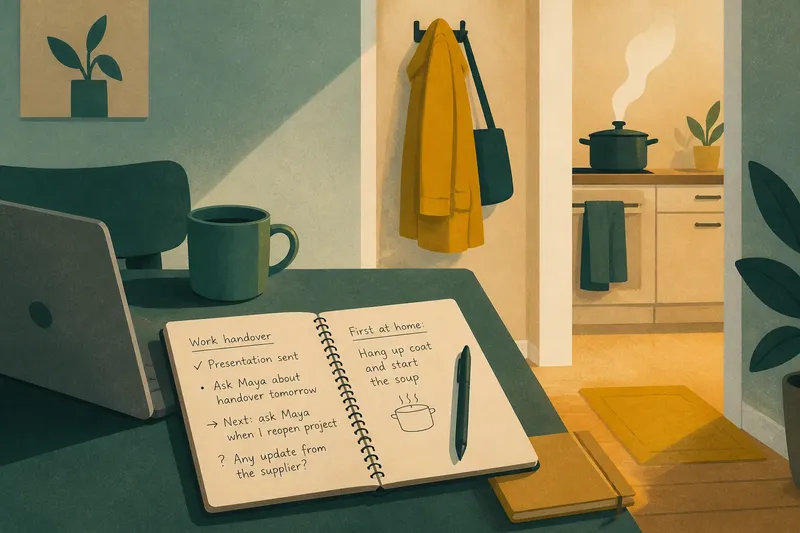
You close the laptop, but the reply you meant to send follows you towards the kitchen. A five-minute transition from work time to home time can capture that loose end and give the evening a definite first action. It is a handover between responsibilities, not a demand to feel calm on cue.
A work handover keeps loose ends specific
Work can stop abruptly: a meeting overruns, a child needs collecting, or the next task remains unfinished when you have to leave. A useful handover separates what is done from what still needs attention, so an open task does not turn into a vague sense that the whole day is incomplete.
Use a notebook, an existing task list or a plain text file. Record only the information needed to resume: the unfinished item, its next action and, if relevant, when you intend to return to it. This is not a review of your performance or a plan for every task tomorrow.
Record the next action rather than carrying the problem
Write a factual line about completed work, then a separate line for anything still open. “Sent the draft; still need the delivery date” is clearer than “The project is nearly done.” If the next action is known, add it: “Ask Maya about the delivery date when I reopen the project.”
If you do not yet know what to do next, record the question instead of inventing an answer. “Check whether the supplier has confirmed the date” gives you a place to begin without inviting another round of problem-solving as you leave.
Say you have prepared a presentation and still owe a colleague a handover answer. You write, “Presentation sent; ask Maya about the handover tomorrow,” then choose “hang up my coat and start the soup” as your first home action. The open question has a named next step, while the evening begins with something specific rather than an attempt to solve work on the way home.
Choose an arrival action that fits the actual evening
Name one thing you can do first at home: put the kettle on, feed the cat, change out of work clothes or greet someone waiting for you. Choose for the arrival you are actually likely to have, not an imagined quiet evening.
If someone needs your attention as soon as you arrive, that can be the first action. If the household is busy, putting down your bag and checking what needs doing may be more realistic than promising yourself a long pause. The point is to make the next responsibility visible, not to prescribe how the evening should feel.
The handover can fit different working arrangements
At home, you might close the work window, put a notebook in a drawer and move to another room. In a workplace, you might write the note before collecting your coat. The physical cue can help mark the change, but the useful part is the clear record of what remains and what begins next.
Some days require a genuine return to work later. If so, write down the specific time or condition that will bring you back to it, along with the task you will handle then. “Check later” leaves the boundary vague; “reply after the school meeting” gives the decision a clearer shape.
It is not worth the effort to buy a special notebook, build a playlist or design an elaborate sequence unless you already enjoy those things. Extra equipment cannot make an unclear handover clearer. Use a tool you already reach for and keep the note brief.
What should you do when work is still open?
What belongs in a handover note?
Include the unfinished item, the next action and any relevant point for resuming it. If you cannot yet identify an action, write the question you will need to answer when you return.
Can this work when I work from home?
Yes. Close or put away the materials you can, record the open task in your usual system and choose a first home activity. A change of room may help mark the shift, but it is optional.
What if an urgent message arrives?
Decide whether it truly needs a response now or can wait for your next work period. If you do respond, name what will mark the end of that response so an unspecified check-in does not reopen the entire workday.
Does the transition have to last five minutes?
No. Five minutes is a loose limit for making the handover, not time you need to fill. Take enough time to record what remains and choose what you will do first at home.
A clear handover leaves room for the evening
A five-minute transition from work time to home time rests on two decisions: what is finished for now, and what comes first at home. On a busy day, a couple of lines may be enough; on a tangled one, a short note can hold the details. The final useful question is whether you could resume the open task from what you wrote. If the answer is yes, the handover has done its job, even if work is still on your mind.